
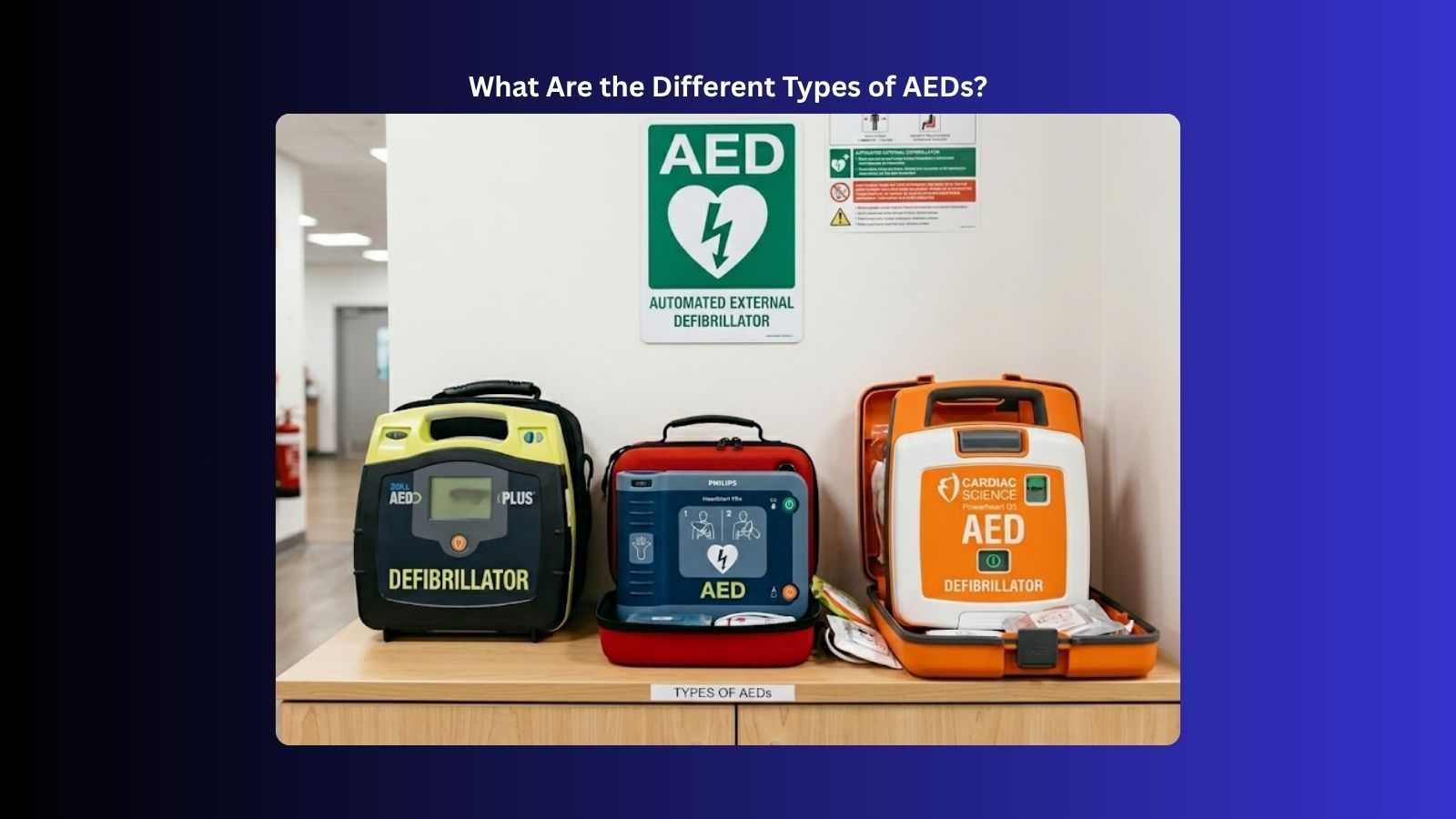
AEDs (Automated External Defibrillators) are not all built the same way. Some deliver a shock automatically, others require a button press. Some are made for untrained bystanders in public spaces, while others are for paramedics and clinical staff. There are devices made specifically for children, models built for home use, and wearable versions prescribed for people at ongoing cardiac risk.
Understanding the different types of AEDs, what sets them apart, and for whom each one is intended is the starting point for determining which device belongs in a given setting and why.
The Two Core Types: Fully Automated and Semi-Automated
The most fundamental distinction between AEDs is whether the device delivers the shock on its own or asks the user to press a button.
1. Fully Automated AEDs (f-AEDs)
Manufacturers design fully automated AEDs to handle the entire process once someone places the electrode pads on the patient’s chest. The device analyzes the heart’s electrical rhythm, determines whether a shock is needed, counts down a warning for bystanders to stand clear, and delivers the shock automatically without requiring a button press. Voice prompts guide the user through every step, which makes these devices ideal for people with no medical background.
Airports, shopping centers, stadiums, and schools most commonly place fully automated AEDs in public areas where a panicked bystander often acts as the first responder.
2. Semi-Automated AEDs (s-AEDs)
Manufacturers design semi-automated AEDs, sometimes called shock-advised AEDs, to analyze the heart rhythm the same way but stop short of delivering the shock automatically. When the device detects a shockable rhythm, it signals the user with a flashing button and a voice prompt that instructs the user to press the shock button manually. This brief pause allows the user to visually confirm that no one touches the patient before the shock is delivered. Trained first responders, workplace safety teams, and anyone who has completed basic AED training prefer semi-automated devices because that moment of human confirmation adds a meaningful layer of control.
Both types are effective and built to prevent accidental shocks to a normal heart rhythm. The choice between them generally comes down to the skill level of whoever is likely to reach for the device.
Pediatric AEDs
Manufacturers calibrate standard AED pads and shock energy levels for adult bodies. Delivering full adult energy to an infant or small child carries real risk, which drives the development of pediatric-specific AEDs.
Pediatric AEDs either use smaller pads that automatically reduce shock energy or include a pediatric mode switch that lowers the joule output to a safer range for children under eight years old or weighing less than 25 kilograms. Schools, daycare facilities, pediatric clinics, and homes with young children benefit from having access to a pediatric-capable device, so they treat it as a worthwhile upgrade over a standard adult AED.
Some manufacturers include pediatric keys or pads as accessories for adult AEDs, allowing one device to serve both adults and children. When people compare AEDs for mixed-age environments, they check for this feature before purchasing.
AEDs by Setting and User Type
Beyond the automated vs. semi-automated distinction, manufacturers and health organizations also group AEDs by the environment of use and by the training level of the person handling them.
1. Public access AEDs
Organizations made public access AEDs for the general public. They assume users have little or no formal training and design them to be as straightforward as possible, including clear pictograms, simple voice instructions, and minimal decision-making. Organizations typically house these devices in bright, wall-mounted cabinets that trigger an alert when someone opens them, and they place them in busy locations so bystanders can reach them before emergency services arrive.
2. Professional-use AEDs
Professional-use AEDs are a distinct category entirely. These devices are built for paramedics, emergency physicians, and trained clinical staff who respond to cardiac emergencies frequently and need more information and control than a public-access device offers. Professional AEDs typically show live ECG readings, allow manual override, and, in more advanced models, support cardiac pacing and drug delivery. They come in three types:
- ALS (Advanced Life Support) defibrillators are carried by paramedics and used in pre-hospital care, most often inside ambulances. They go well beyond basic defibrillation, covering 12-lead ECG interpretation, pacing, and in some models, medication administration.
- Manual external defibrillators give clinicians full hands-on control. The operator reads the ECG directly, chooses the appropriate energy level, and decides when to deliver the shock. These are used when the treating clinician needs complete control over every step of the process.
- In-hospital defibrillators are the most advanced of the three. Found in ICUs, operating rooms, and emergency departments, they work alongside other hospital monitoring equipment and are used for the most seriously ill patients in supervised clinical settings.
3. Wearable AEDs
A wearable AED is a vest-like device that people wear directly against the skin, and it continuously monitors the heart’s rhythm day and night. If it detects a life-threatening arrhythmia, it delivers a shock automatically without requiring a bystander or a button press.
Doctors typically prescribe wearable AEDs as a temporary measure for patients who have recently had a heart attack, undergone cardiac surgery, or learned that they have a condition that significantly increases their risk of sudden cardiac arrest but who are not yet candidates for a permanent implanted device. These devices provide close monitoring during a vulnerable period, and patients usually wear them for weeks to months under a cardiologist’s care.
4. Home-Use AEDs
Home-use AEDs are compact, straightforward devices designed for everyday households without medical training. They use the same basic technology as public-access AEDs but come in smaller, more affordable designs suited for personal ownership. They include simple voice prompts that guide users step by step, and they remind owners when maintenance is needed. Their small, lightweight design also allows people to store them in a kitchen drawer or bedside cabinet.
For people living with a heart condition, a family history of sudden cardiac arrest, or other known risk factors, keeping a home AED nearby provides a real safety net during the minutes before an ambulance arrives. Most cardiac arrests happen at home, which means even the best-equipped public spaces cannot help when it matters most.
ICDs: Related, But Not the Same
You should know about Implantable Cardioverter Defibrillators (ICDs), even though they are not AEDs in the traditional sense. Every device covered above is external, and responders use it during an emergency. In contrast, a surgeon surgically places an ICD inside the chest, and it works around the clock without any outside involvement.
An ICD keeps watch over the heart’s rhythm every hour of every day. When it picks up a dangerous arrhythmia such as ventricular fibrillation or ventricular tachycardia, it delivers a shock internally to bring the heart back to a normal rhythm. Many ICDs also work as pacemakers, sending small electrical pulses to keep the heart beating steadily when needed. Cardiologists recommend them for people with a high risk of sudden cardiac arrest, and a cardiologist always decides to implant one after thoroughly reviewing the patient’s heart history.
The simplest way to think about the difference is this: an AED steps in during a crisis. An ICD works quietly in the background, every single day, for people who cannot afford to wait for one.
Choosing the Right AED
The right AED comes down to who will be using it and where. For general public spaces, a fully automated device with clear instructions is the safest choice. For trained responders and workplace safety programs, a semi-automated device gives more control. Spaces where children are present need pediatric capability. People at higher risk who live alone will often get the most reassurance from a home-use device or, after speaking with their doctor, a wearable AED.
What matters most is that an AED is present, easy to reach, and suited to its surroundings. The best AED is always the one that is there when people need it.
Prepare to Save Lives With an AED
Now that you understand the different types of AEDs, you are more prepared than many people around you. Whether you notice one on a gym wall, watch a paramedic take one from a bag, or consider getting one for your home, you now have a clearer idea of what each device does and whom each device serves. What matters most is choosing an AED that fits the setting, the people using it, and those it may need to help.
A fully automated model suits busy public places where anyone might step in, while a semi-automated one gives trained responders more control. Pediatric options help keep children safe, and wearable or home devices support individuals who face a higher personal risk. Regardless of the type, all AEDs aim to provide quick help when every minute counts. Understanding these devices can help you feel more ready to respond quickly and possibly make a life-saving difference.