
Picking the right CPR training provider feels overwhelming when so many options are out there, but the choice you make truly matters. Good training builds practical skills you can use in a crisis, while a poor course might leave you with a certificate that means very little when someone needs help. This guide walks you through everything you need to know to find a provider who gives you genuine confidence, recognized credentials, and the hands-on practice that makes all the difference.
Why Choosing the Right Provider Matters
CPR programs vary widely in quality, and that gap matters when an emergency happens. The provider you choose shapes how confidently and correctly you respond. Strong training delivers up-to-date techniques, hands-on practice, and a certification that employers and institutions actually recognize. Choosing well is not just about ticking a compliance box; it is about being genuinely ready to save a life when it counts.
Check Accreditation and Certification Validity
When choosing a CPR training provider, pay close attention to accreditation and certification validity. The right certification confirms that your skills are accurate, up to date, and trusted by employers and institutions.
1. Importance of Recognized Certifications
A recognized CPR certification reflects the quality and reliability of your training. It tells employers and institutions that:
- The course follows scientifically backed guidelines.
- Training methods meet standardized, regularly updated standards.
- Employers and organizations trust and accept the certification.
- You have built practical, life-saving skills, not just theoretical knowledge.
Without proper recognition, a certification may not hold up for jobs, compliance checks, or professional requirements.
2. Look for Affiliation with a Reputable Organization
Look for providers affiliated with a nationally or internationally recognized accrediting body. These affiliations signal that the program follows evidence-based guidelines, meets standardized training benchmarks, and produces certifications that employers and institutions are likely to accept. Accredited providers typically offer structured courses across basic and advanced levels, with content that reflects current best practices in emergency cardiovascular care.
How to verify accreditation: Check the provider’s website for accreditation details, then cross-reference by searching the accrediting body’s official directory or approved provider list. If a provider cannot point you to a verifiable accrediting organization, that is a red flag.
3. Make Sure Your Certification Fits Your Needs
Before enrolling, confirm the certification will serve your intended purpose:
- Workplace Requirements: Many employers specifically require training from accredited providers, particularly in healthcare, education, and fitness.
- Professional Credibility: Healthcare and other industries widely respect certifications from recognized organizations because of their rigorous training standards.
- Validity and Renewal: Most certifications need renewal every two years to keep your skills current.
- Practical Competence: Accredited courses put hands-on practice at the center, so you build confidence and can respond effectively in an actual emergency.
Choosing a CPR training provider affiliated with a recognized accrediting body means your certification carries genuine weight, earns wide acceptance, and truly prepares you to act when someone’s life is on the line.
Evaluate Course Content and Curriculum
When selecting a CPR training provider, take time to examine the course content and curriculum closely. Strong programs deliver comprehensive, practical, and evidence-based training that prepares you for life emergencies.
1. Does It Include Essential CPR Skills?
A strong CPR course covers techniques for all age groups.
Adult, Child, and Infant CPR
Age-specific CPR techniques matter because the right approach depends on the victim’s size and condition. Learning all three prepares you to respond at home, at work, or in public.
Complete Emergency Response
Quality courses typically cover recognizing cardiac arrest, performing high-quality chest compressions, delivering rescue breaths, and managing choking across different age groups.
2. AED Training
AED training should be a core part of any credible CPR course. Using an AED alongside CPR significantly raises survival rates in cardiac arrest cases. Training should cover:
- How to operate an AED safely.
- When to use it during an emergency.
- How to combine AED use with effective CPR.
Hands-on AED practice builds the confidence and speed you need to act quickly under pressure.
3. First Aid Basics
Many strong CPR programs combine first aid training with CPR instruction. This broadens your ability to handle a wide range of emergencies beyond cardiac arrest. First aid basics typically include managing bleeding and wounds, treating burns and injuries, and recognizing shock and other medical emergencies. This combined approach leaves you better prepared for the emergencies you are most likely to face day to day.
4. Alignment with Latest CPR Guidelines
Reputable providers regularly update their curriculum based on the latest research in emergency cardiovascular care. Look for courses that reflect current best practices in compression rate and depth, rescue breathing techniques, and overall emergency response protocols. Choosing a provider that keeps its curriculum current means you receive accurate, hands-on training that gives you the skills and confidence to act when it counts.
Training Format and Flexibility
When choosing a CPR training provider, the format and flexibility of the course shape how well you learn and retain the skills. Good providers offer multiple training formats to fit different learning styles, schedules, and professional needs.
1. What Training Formats Should a Good Provider Offer?
Look for providers that offer at least the following:
- Blended Learning (Online + In-Person): A two-part format where you complete the theoretical portion online at your own pace, then attend an in-person session to demonstrate and verify practical skills. This saves time in the classroom without sacrificing competency checks.
- Fully In-Person Training: A format where demonstration and hands-on practice all happen in a single session. Well-suited for learners who prefer direct interaction and guided support throughout.
- Skills Renewal Sessions: A focused in-person assessment for those renewing an existing certification. Rather than repeating full coursework, learners go directly to hands-on skills practice and evaluation.
A reliable provider will be transparent about what each format includes, how long each takes, and which one best suits your needs and certification requirements.
2. What to Look for in Any Format
Regardless of which format a provider offers, these elements should always be present:
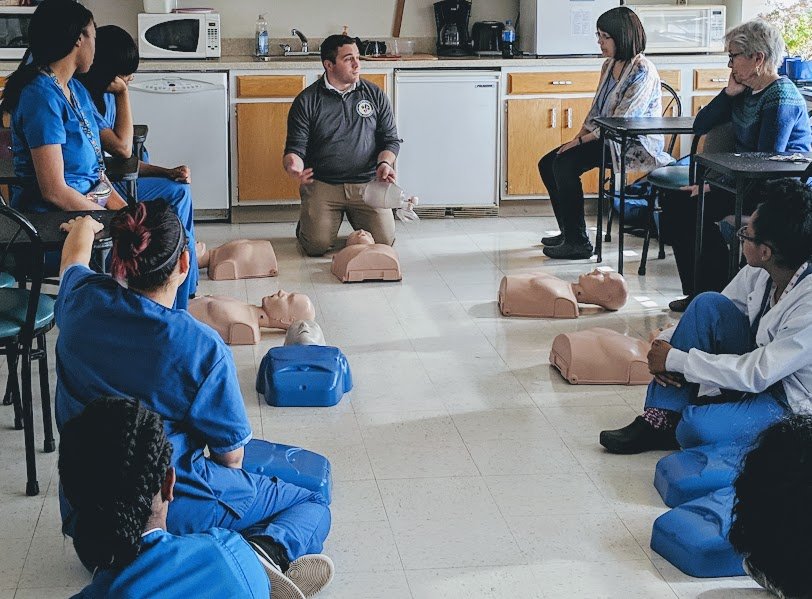
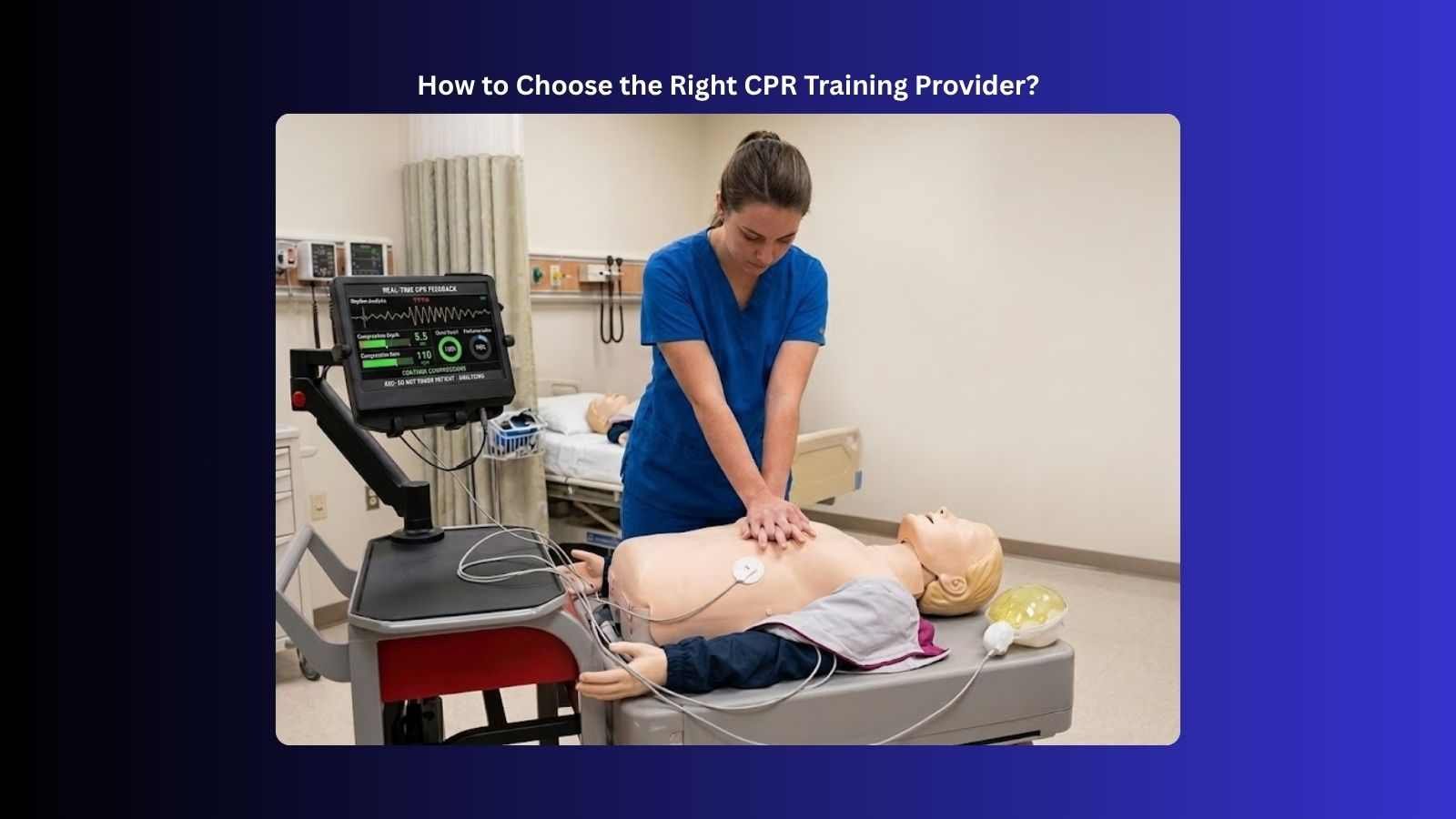
- Hands-on practice with manikins and AED training devices.
- Real-time feedback on technique, from a feedback-enabled simulation tool.
- Skills evaluation before certification is issued, not just a written quiz.
Avoid any provider whose format relies entirely on slides, videos, or online quizzes without a practical component. CPR is a physical skill, and no amount of reading or watching replaces doing it.
3. Class Schedules and Availability
Scheduling flexibility matters. Look for providers that allow online portions to be completed at your own convenience, offer multiple time slots for in-person sessions, and accommodate both individuals and groups. Training should fit into your routine, not disrupt it.
Questions to Ask a Provider Before Enrolling
Before committing to any CPR training provider, ask these questions directly:
- Is your program accredited, and by which organization? A legitimate provider will answer this immediately and clearly.
- What does the course include? Confirm it covers CPR for adults, children, and infants, AED use, and hands-on practice.
- What certification will I receive, and how long is it valid? You should know exactly what you are earning and when it expires.
- How do I renew my certification? A good provider has a clear renewal pathway.
- Is hands-on practice included, or is this an online-only course? Never accept a purely digital CPR certification.
- Do you offer group or on-site training? Important if you are enrolling a team or workplace.
If a provider is evasive, vague, or cannot answer these questions upfront, look elsewhere.
Location and Accessibility
Location and accessibility determine whether you actually complete your training, not just whether you sign up. Even a strong course fails you if getting there becomes a barrier.
1. Proximity to Your Home or Workplace
A training center close to home or work cuts travel time and makes consistent attendance far easier. You can fit evening or weekend sessions into your routine, arrive on time, and focus on practice rather than recovering from a long commute.
2. On-Site and Corporate Training Options
Many providers bring training directly to your location, whether a home, school, or workplace. Corporate programs serve groups across offices, hospitals, and industrial settings, with scheduling built around organizational needs. This works especially well when multiple staff members need certification at once.
3. Individual vs. Group Training Considerations
If you are enrolling as an individual, prioritize a provider with flexible scheduling and a convenient location. If you are enrolling a team or organization, look for providers that offer on-site delivery, volume pricing, and scheduling that minimizes disruption to your operations. Some providers specialize in corporate or institutional training and can coordinate certification for large groups in a single session.
Reviews and Reputation
When selecting a CPR training provider, reviews and reputation offer insight that course descriptions alone cannot. Online reviews from past students frequently highlight clear guidance, hands-on practice, and confidence-building as hallmarks of strong courses, with positive feedback often reflecting that learners left feeling genuinely prepared for emergencies.
Personal recommendations from colleagues, employers, and peers carry equal weight, especially in healthcare, education, and safety-sensitive fields, often surfacing details about training quality and day-to-day usefulness that written reviews may miss. Firsthand accounts from past students further reinforce this, with many reporting greater confidence, sharper emergency readiness, and in some cases, real-life situations where their training made a difference.
Ultimately, a provider with strong reviews, consistent word-of-mouth, and proven success stories signals training that builds practical ability, earns employer trust, and leaves learners with the skills to actually save a life, not just a certificate to file away.
Cost and Value for Money
Cost matters when choosing a CPR training provider, but price alone should never drive the decision. Weigh it against training quality, certification credibility, and practical value.
1. Compare Pricing Across Providers
CPR training costs vary by course type, location, and format. Basic CPR and AED courses sit in a moderate price range, while advanced or healthcare-level courses cost more due to deeper content and stricter certification requirements. In-person, blended, and materials-inclusive options also affect the final price. Courses from accredited providers set a reliable benchmark and tend to earn broader acceptance from employers and institutions than unrecognized alternatives.
2. What the Cost Should Cover
Before committing, confirm the fee includes training materials, hands-on practice with manikins and AED trainers, an official certification card, and renewal options. Most accredited certifications run for two years. Providers that bundle thorough hands-on training with recognized certification offer better value than those that cut corners on price.
3. Avoid Choosing on Price Alone
Budget programs often skip hands-on practice, offer certifications that employers reject, and put forward instructors with uneven experience. You may end up paying twice when you need to retake a credible course. Training from an accredited provider builds standardized skills that hold up in an actual emergency.
Look at the overall value, not just cost. A program with hands-on practice, recognized certification, and structured content prepares you to act when it counts, and that is worth more than the cheapest option on the list.
Certification Renewal and Support
Understanding how certification renewal works before you choose a CPR training provider saves you time and keeps your skills from lapsing. Reliable programs follow a clear, structured renewal process that keeps your training current.
1. Validity Period
Most accredited certifications remain valid for two years. That two-year cycle keeps learners current with the latest emergency cardiovascular care guidelines, since techniques and recommendations do shift over time.
2. Renewal and Refresher Courses
As your certification approaches its expiration date, reputable providers offer focused renewal options. Renewal courses cover the same core skills: CPR for adults, children, and infants, AED use, and updated emergency response techniques. Many learners complete an online knowledge review first, then attend an in-person session for hands-on skills practice. Renewal still requires a full skills evaluation to confirm competence. The process moves faster than initial training but holds to the same standards.
3. Post-Training Support
A good provider does not disappear after you receive your card. Look for access to updated guidelines and learning materials, practice tools to keep skills sharp between renewals, and renewal reminders to avoid certification gaps. Training center support for technique questions or recertification guidance is also worth confirming before you sign up.
Renewal and ongoing support are not extras. They are part of what makes CPR training genuinely useful over time. A reliable provider keeps your certification valid, your skills sharp, and your confidence high when an emergency demands it.
Signs You Should Watch Out For
Spotting a poor CPR training provider matters just as much as finding a good one. A substandard course can leave you underprepared when it counts, even if you walk away with a certificate.
1. Unaccredited Providers
Steer clear of providers that lack accreditation or have no affiliation with recognized organizations. Unaccredited courses often ignore current evidence-based guidelines, and the certifications they issue frequently go unrecognized by employers, schools, and regulatory bodies.
2. No Hands-On Training
CPR is a physical skill. Any course that runs mostly on lectures and slides without a manikin or AED practice will not prepare you for an emergency. You should physically demonstrate CPR technique before receiving any certification.
3. Unrealistically Short Courses
A course that promises full certification in a suspiciously short time is cutting something out. Proper CPR training needs time for instruction, demonstration, and repeated practice. Quick certifications tend to prioritize convenience over actual competence.
4. Vague Certification Details
A trustworthy provider clearly states what certification you receive, who issues it, how long it lasts, and how to renew it. Missing or unclear answers to any of these questions are a strong signal to look elsewhere.
5. High-Pressure Sales Tactics
Legitimate training providers let the quality of their program speak for itself. Be cautious of providers that push you to enroll immediately, offer steep last-minute discounts to rush your decision, or cannot give you time to compare options.
A credible CPR course offers accredited instruction, hands-on practice, adequate training time, and transparent certification details. If a provider falls short on any of these, keep looking.
Find the Right CPR Provider and Be Ready to Save Lives
In summary, choosing the right CPR training provider comes down to a few key things: solid accreditation, thorough hands-on practice, clear certification details, and a program that fits your schedule and budget. Take your time, ask direct questions, and trust providers who answer them openly. The effort you put in now pays off the moment someone near you needs help. Good training does more than earn you a card. It gives you the ability and the confidence to step in and truly make a difference.
At Bayside CPR, we offer American Heart Association (AHA) CPR training along with BLS, ACLS, and PALS. Our flexible hybrid program lets you complete the online portion at your own pace and finish with a brief 30-minute skills session at a CPR Verification Station. Receive your certification the same day and take advantage of our 100% pass rate. We operate in 15 states (DE, DC, GA, KY, LA, MD, MO, NJ, NY, NC, OH, PA, SC, TX, and VA) and more than 65 cities across the United States, making it easy for you to enroll in a location near you.