American Heart Association Training Center
The release of the 2025 American Heart Association guidelines brings critical updates to the Adult Basic Life Support (BLS) Algorithm for healthcare professionals. These guidelines build upon prior versions with updated recommendations for the assessment and management of cardiac arrest, respiratory arrest, and foreign-body airway obstruction (FBAO).
The adult BLS algorithm provides a streamlined, evidence-based roadmap for responding to these emergencies, addressing the important elements of initial recognition of cardiac arrest, activation of emergency response, provision of high-quality cardiopulmonary resuscitation (CPR), and use of an automated external defibrillator (AED). New to the 2025 algorithm, the use of opioid antagonists (eg, naloxone) during respiratory or cardiac arrest has been incorporated. Early, high-quality CPR and prompt defibrillation remain the most important interventions associated with improved outcomes in adult cardiac arrest. This guide breaks down the latest 2025 algorithm step by step, ensuring you have the knowledge to act quickly, precisely, and with confidence.
Note: This adult basic life support algorithm guideline is valid for 2025–2030
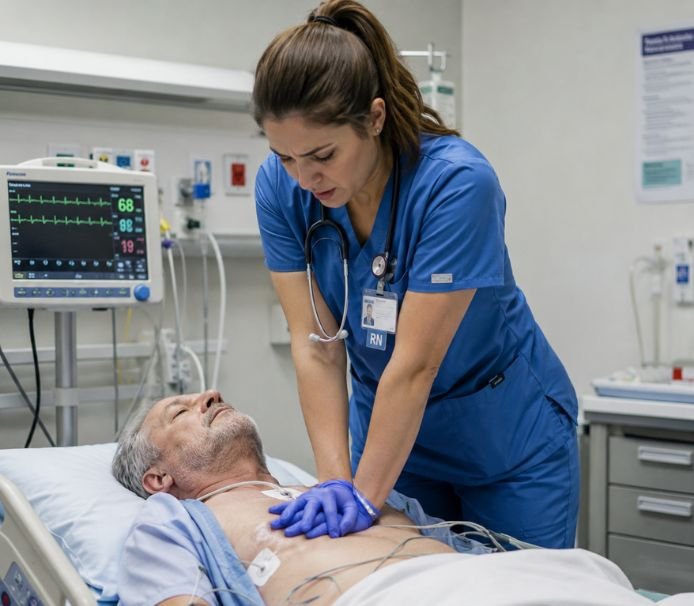
The Adult BLS Algorithm for Healthcare Professionals is the official decision-making framework published by the American Heart Association for resuscitating adults in cardiac arrest. It is developed specifically for trained medical providers, distinguishing it from the separate algorithm created for lay rescuers.
The algorithm presents a sequential flowchart that guides providers through critical decision points, beginning with patient assessment and progressing through chest compressions, airway management, and defibrillation.
It accounts for various clinical scenarios, including respiratory arrest with a pulse, cardiac arrest with shockable versus nonshockable rhythms, and opioid-associated emergencies.
The 2025 version streamlines the decision-making process by eliminating unnecessary steps and emphasizing interventions that have the greatest impact on survival. Healthcare professionals can follow this structured pathway to deliver consistent, high-quality care during the high-stress moments of resuscitation.
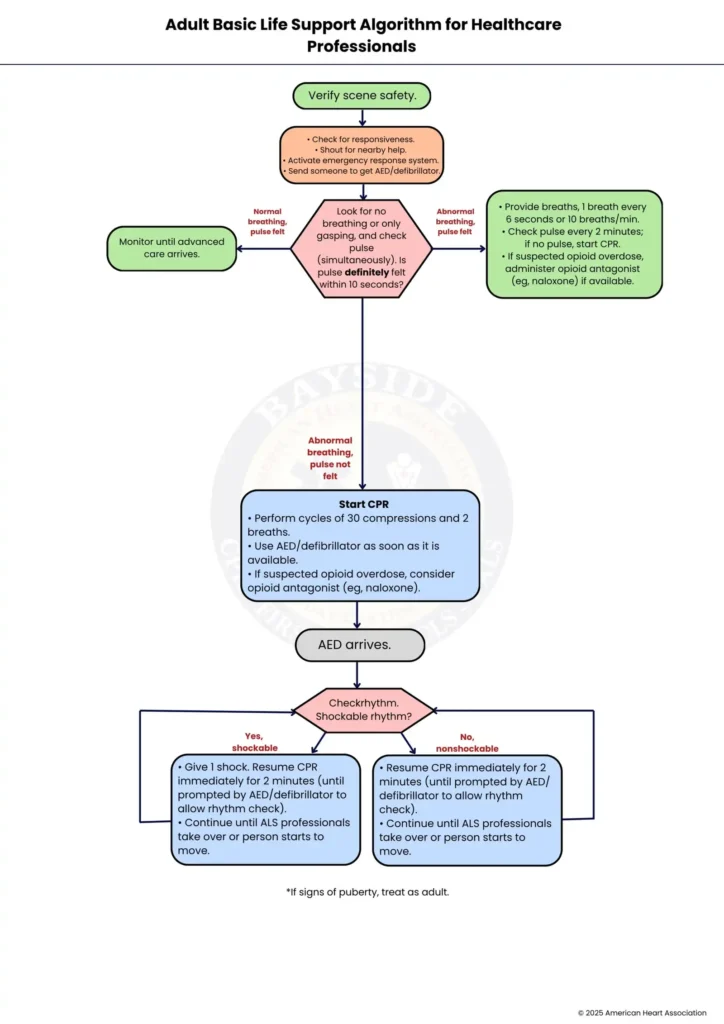
The adult basic life support algorithm guides healthcare professionals in responding to cardiac emergencies. This guide explains each action in clear steps so you can respond quickly and confidently when someone needs urgent help.
Before approaching the victim, ensure the environment is safe for both the rescuer and the patient. Check for any hazards such as traffic, fire, electricity, or other dangers that could cause harm. Do not intervene until the scene is secure, as rescuing in an unsafe environment may put both lives at risk.
Next, check if the person responds to you. Shout for nearby help, activate the emergency response system (like calling 911), and send someone to get an automated external defibrillator (AED).
Look to see if the person is not breathing or is only gasping, while simultaneously checking for a pulse. You should do this for no more than 10 seconds. If you find normal breathing and a pulse, go to Step 4. If you find abnormal breathing but a pulse, go to Step 5. If there is no breathing or only gasping, and you cannot feel a pulse, go to Step 6.
If the person is breathing normally and has a pulse, simply stay with them and monitor their condition until advanced medical help arrives.
If the person has a pulse but is not breathing normally, you will need to provide rescue breaths. Give 1 breath every 6 seconds, which equals ten breaths per minute. You should recheck their pulse every 2 minutes; if you no longer feel a pulse, begin CPR. If you suspect the person is suffering from an opioid overdose, administer an opioid antagonist like naloxone if it is available.
If the person has no pulse and is not breathing or is only gasping, begin CPR. Perform cycles of 30 chest compressions followed by 2 rescue breaths. Use the AED or defibrillator as soon as it is available. If you suspect an opioid overdose, consider administering an opioid antagonist like naloxone.
When the AED arrives, turn it on and follow its instructions.
The AED will check the heart’s rhythm. If the rhythm is shockable, go to Step 9. If the rhythm is not shockable, go to Step 10.
If a shock is advised, deliver one shock. Immediately after the shock, resume CPR for two minutes, continuing until the AED prompts you to pause for another rhythm check. Keep repeating this process until advanced life support professionals take over or the person starts to show signs of movement.
If no shock is advised, immediately resume CPR for two minutes, continuing until the AED prompts you to pause for another rhythm check. Keep repeating this process until advanced life support professionals take over or the person starts to show signs of movement.
Key Note: If signs of puberty are present, treat as an adult.
In summary, the updated adult basic life support guidance gives health care professionals a clear and practical approach to respond to life-threatening emergencies. It helps providers quickly recognize problems, call for emergency support, and start chest compressions and breathing support without delay. The focus on early compressions and fast use of a defibrillator improves the chance of survival for adults in cardiac arrest. It also highlights careful assessment of breathing and pulse so the right care is given at the right time. The addition of an opioid antagonist option supports better response in suspected overdose cases. Overall, this approach encourages fast thinking, steady action, and coordinated teamwork in critical moments. Following these updates helps providers deliver safer care and improve outcomes for patients in need.
Learning and remembering these steps prepares you to respond in an emergency, and it helps you protect those around you with care and confidence. Sign up for our BLS course at Bayside CPR and learn reliable life-saving skills for adult emergencies.
First, make sure the scene is safe so you do not get hurt. Then check if the person responds, call emergency help, and send someone to bring an AED.
Look at the person’s breathing and feel for a pulse at the same time. Do this quickly and take no more than 10 seconds.
Give rescue breaths, one breath every 6 seconds, which is about 10 breaths per minute. Recheck the pulse every 2 minutes and give naloxone if opioid overdose is suspected and available.
Start CPR if the person has no pulse and is not breathing or is only gasping. Use cycles of 30 chest compressions and 2 breaths until help arrives or the AED takes over.
Turn on the AED and follow its voice instructions when it arrives. If it advises a shock, give one and then continue CPR right away, or keep doing CPR if no shock is needed.