American Heart Association Training Center
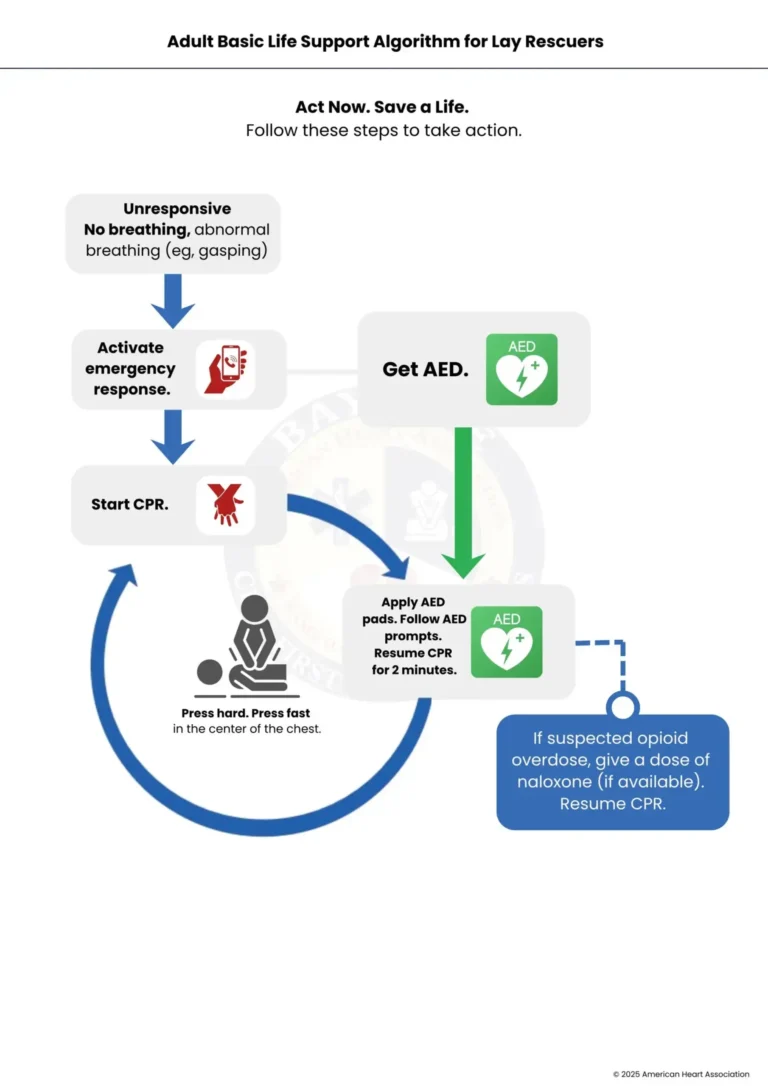
The Adult Basic Life Support (BLS) Algorithm for lay rescuers is a standardized set of steps developed to guide non-medical individuals in providing immediate care to an adult experiencing cardiac arrest. It focuses on the rapid recognition of unresponsiveness, prompt activation of emergency medical services, and the initiation of high-quality cardiopulmonary resuscitation (CPR) along with early use of an automated external defibrillator (AED). This algorithm plays a crucial role in improving survival outcomes by ensuring timely intervention before professional medical help arrives.
Note: This adult basic life support algorithm for lay rescuers guideline is valid for 2025–2030
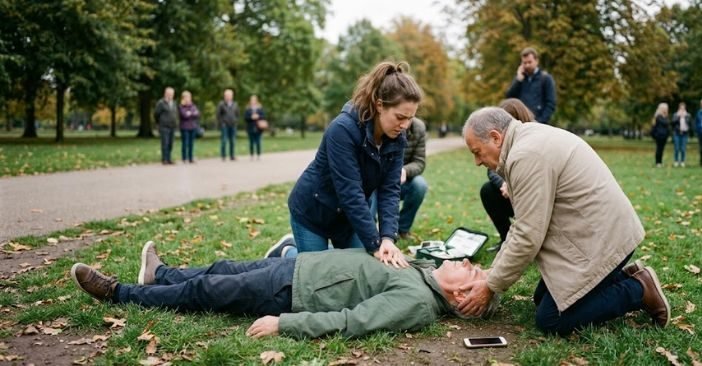
Helping someone in an emergency can feel scary, but knowing what to do makes a big difference. This simple guide walks you through each step, so you can act quickly and confidently when it matters most.
The first step is to quickly assess the person for signs of life. Tap their shoulders firmly and shout, "Are you okay?" If there is no response, look for normal breathing. If the person is not breathing or is only gasping, which is an abnormal, irregular breathing pattern that may occur in the early stages of cardiac arrest, assume they are in cardiac arrest and act immediately. Do not waste time checking for a pulse, as lay rescuers are not expected to do so.
Once cardiac arrest is recognized, the rescuer should immediately activate the emergency response system. In most settings, this means calling 911 (or the local emergency number) or shouting for someone nearby to make the call. If a second rescuer is present, tasks should be divided simultaneously to save precious time: one person should go to retrieve an AED (Step 3) while the other begins CPR right away (Step 4). Every moment is crucial in cardiac arrest, as the chances of survival decrease by roughly 10% for every minute without defibrillation or chest compressions, so this parallel approach, rather than doing tasks one after another, is a critical strategy in the lay rescuer response.
It involves retrieving an AED as quickly as possible. An AED is a portable, easy-to-use device that can analyze the heart's rhythm and deliver an electric shock (defibrillation) to restore a normal heartbeat in cases of sudden cardiac arrest caused by shockable rhythms such as ventricular fibrillation or pulseless ventricular tachycardia. Lay rescuers should be aware of the nearest AED location in their environment, commonly found in airports, schools, shopping centers, and other public spaces. Once retrieved, the rescuer proceeds directly to Step 5, where the AED will be used. Importantly, fetching the AED should never delay the start of CPR, which is why, when two rescuers are present, one retrieves the AED while the other immediately begins chest compressions, ensuring no interruption in the chain of survival.
Begin CPR immediately by placing the heel of one hand on the center of the person's chest (on the lower half of the breastbone), placing the other hand on top, and pushing down hard and fast. Compressions should be at least 2 inches deep and delivered at a rate of 100–120 per minute. Allow the chest to fully recoil between compressions. If trained, give rescue breaths after every 30 compressions. If untrained or unwilling, continue hands-only CPR without interruption until the AED arrives; then proceed to Step 5.
Once the AED arrives, turn it on and follow the voice and visual prompts carefully. Attach the electrode pads to the person's bare chest as shown in the diagrams on the pads, one below the right collarbone and one on the lower left side of the chest. The AED will analyze the heart rhythm and instruct you to deliver a shock if needed. Ensure no one is touching the person during the shock. Immediately after the shock (or if no shock is advised), resume CPR for 2 minutes before the AED re-analyzes. Continue cycling between CPR (Step 4) and AED (Step 5) prompts until emergency help arrives. If there’s a suspected opioid overdose, proceed to Step 6.
If there are signs suggesting an opioid overdose, such as a known history of opioid use, presence of drug paraphernalia, or pinpoint pupils, and naloxone (Narcan) is available, administer it according to the instructions on the package (typically as a nasal spray). Naloxone is a safe, fast-acting medication that can reverse the effects of opioid overdose. After administering naloxone, immediately resume CPR as outlined in Step 4 until professional help takes over.
In short, the Adult Basic Life Support Algorithm for Lay Rescuers provides everyday people with a clear and simple way to help save a life. By acting quickly, calling for help, starting strong chest compressions, and using an AED as soon as it is available, anyone can make a real difference during a cardiac emergency. These steps are easy to follow and focus on what matters most, which is keeping blood and oxygen moving until trained professionals arrive. Even without medical training, your quick action can give someone a better chance to survive and recover. Staying calm, acting fast, and following these steps can truly turn a critical moment into a life-saving one. Ready to handle an emergency with confidence? Sign up for our BLS course at Bayside CPR and learn reliable life-saving skills.
Tap their shoulders and shout, “Are you okay?” If they don’t respond and aren’t breathing normally, assume they’re in cardiac arrest. Don’t worry about checking for a pulse. Just act fast!
Call 911 or your local emergency number right away, or ask someone nearby to call while you get started. Don’t wait. The sooner help is on the way, the better.
Place the heel of your hand on the center of the person’s chest, put your other hand on top, and push down hard and fast. Aim for at least 2 inches deep at a rate of 100 to 120 times per minute. Let the chest rise fully between each push.
If you’re not trained or not comfortable giving rescue breaths, hands-only CPR works well. Just keep pushing on the chest without stopping. If you are trained, give 2 rescue breaths after every 30 compressions.
If you notice signs like pinpoint pupils or drug paraphernalia nearby, and you have naloxone on hand, administer it immediately, following the package instructions. Then start CPR and continue until emergency help arrives.