American Heart Association Training Center
According to the American Heart Association (AHA), the Child Foreign-Body Airway Obstruction (FBAO) Algorithm provides a standardized, evidence-based framework for rescuers to assess and manage choking in children, a time-critical, life-threatening emergency. The goal is to enable rapid identification of obstruction severity and execution of appropriate maneuvers to prevent progression to hypoxic cardiac arrest. This algorithm applies to children from 1 year of age up to the onset of puberty (or until the child fits the physical dimensions of adult care).
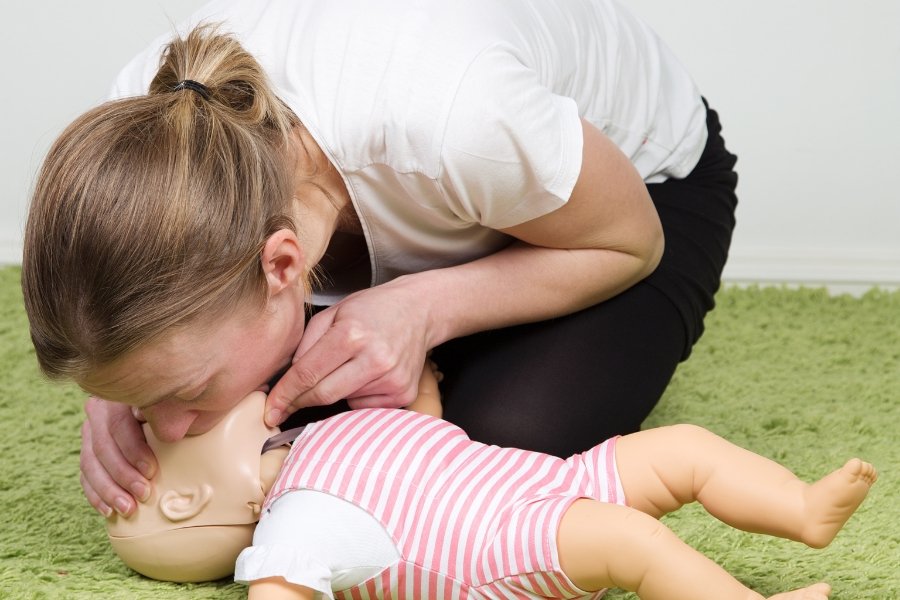
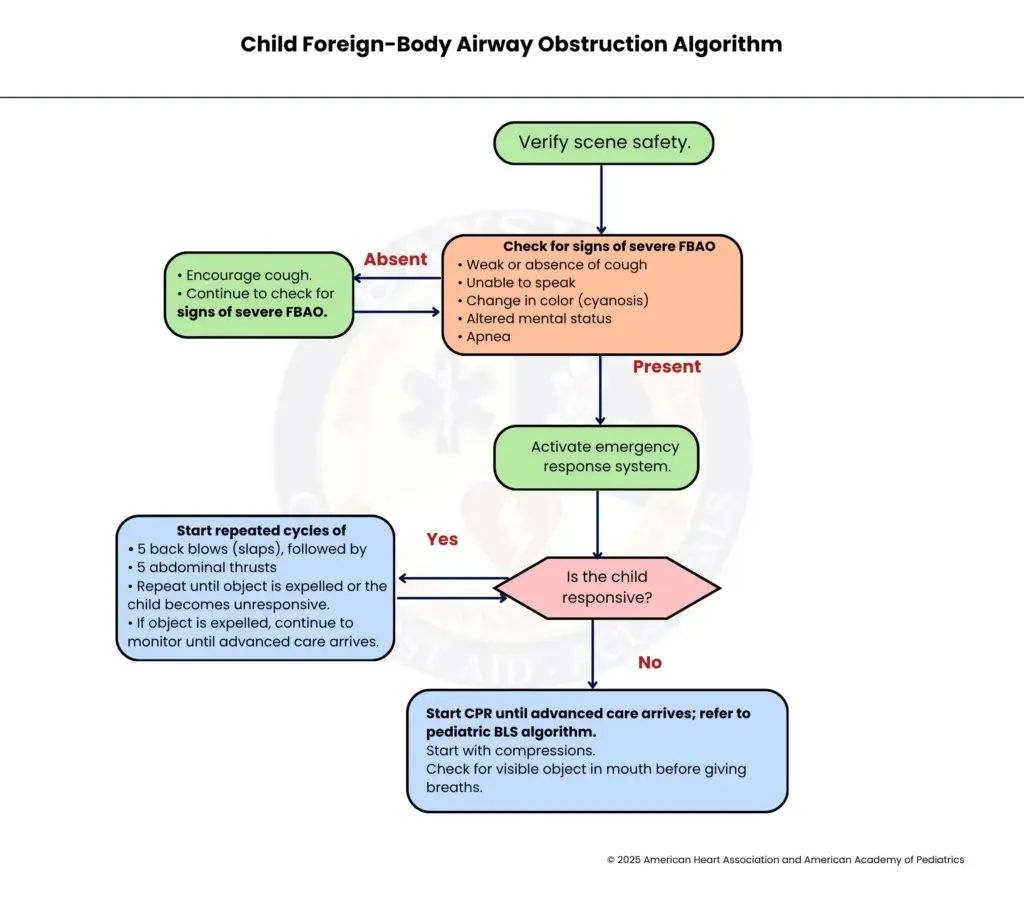
The 2025 AHA and American Academy of Pediatrics guidelines introduce a significant update: the sequence for severe FBAO now begins with back blows before proceeding to abdominal thrusts. This reverses the previous emphasis on abdominal thrusts as the initial maneuver. This represents the first comprehensive update to pediatric FBAO treatment recommendations since 2020.
The change is driven by a lack of high-quality pediatric data, a recent observational study (low certainty) suggesting back blows may be more effective, and an effort to create consistency, aligning the child sequence with the infant algorithm to simplify training and recall for rescuers.
Note: This Child FBAO algorithm guideline is valid for 2025–2030.
01.
Make sure the area is safe for you and the child before you help. Proceed to Step 2.
02.
Once you’ve encouraged the child to cough, you’ll need to quickly assess whether the choking is severe. Look for signs that coughing isn’t clearing the airway and that the situation is becoming an emergency. These include a weak, ineffective cough or no cough at all, an inability to speak or make any sounds, a bluish color around the lips or skin(cyanosis) or signs that the child is fading, meaning they have an altered mental status or have stopped breathing altogether, known as apnea. If none of these signs are present, you can move on to Step 3. But if you do notice any of them, don’t wait, go straight to Step 4.
03.
If the child is conscious and coughing forcefully, let them cough. Their body is trying to push the object out on its own. Do not interfere unless the situation gets worse. Proceed to Step 2.
04.
Call for help (e.g., 911) or have someone else call while you begin care. Proceed to Step 5.
05.
Is the child responsive?
06.
Repeat this cycle until the object comes out or the child becomes unresponsive:
07.
At this point, you should stop back blows and abdominal thrusts and start CPR immediately, following standard child BLS guidelines. Begin with chest compressions, but before giving rescue breaths, quickly look inside the child's mouth. If you can actually see the object, remove it carefully. Just remember never to do a blind finger sweep(meaning you should never stick your finger in without seeing the object) because that can accidentally push it deeper into the airway.
The sequence has changed. Previously, guidelines focused on abdominal thrusts (Heimlich maneuver). The 2025 AHA and AAP guidelines now recommend starting with 5 back blows followed by 5 abdominal thrusts in a repeating cycle for children. This creates consistency with the infant protocol and is based on evidence suggesting back blows may be more effective.
While this applies to CPR rather than active choking maneuvers, the 2025 guidelines retired the two-finger technique for infant compressions due to ineffectiveness in achieving proper depth. Rescuers should use the two-thumb encircling hands technique or the heel of one hand.
No. The Child FBAO Algorithm applies from 1 year of age until the onset of puberty. Once a child shows signs of puberty (chest development in females, underarm hair in males), rescuers should transition to the Adult Choking Algorithm. For infants under 1 year, you must follow the specific Infant FBAO protocol (chest thrusts instead of abdominal thrusts).
If the child begins coughing forcefully again, stop active interventions (back blows and abdominal thrusts). Encourage the child to continue coughing, as this is the body’s most effective natural way to clear the airway. Continue close monitoring in case symptoms worsen.
Even if the object is expelled, the child should still be medically evaluated, especially if:
Airway irritation or residual fragments may still pose risks.