
During a cardiac arrest, several healthcare professionals may need to act at the same time. Without clear roles and instructions, team members may be unsure of who should perform each task, leading to missed or duplicated actions.
Closed-loop communication helps CPR team members communicate clearly and confirm that assigned tasks are understood and completed. The approach creates a clear exchange between the person giving an instruction and the team member carrying it out.
This guide explains closed-loop communication in CPR, including how it works, its benefits, common challenges, practical techniques, training tips, and its role in BLS, ACLS, and PALS.
What is Closed-Loop Communication in CPR?
Call-back communication is a structured approach used during CPR and other resuscitation situations to make sure instructions are clearly given, understood, and followed. The team leader gives a specific instruction to a team member, who confirms the instruction before carrying out the assigned task.
This approach helps reduce misunderstandings and keeps team responsibilities clear during BLS, ACLS, and PALS resuscitation. Each instruction is acknowledged and confirmed, helping the team coordinate critical interventions during an emergency.
How Does Repeat-Back Communication Work During CPR?
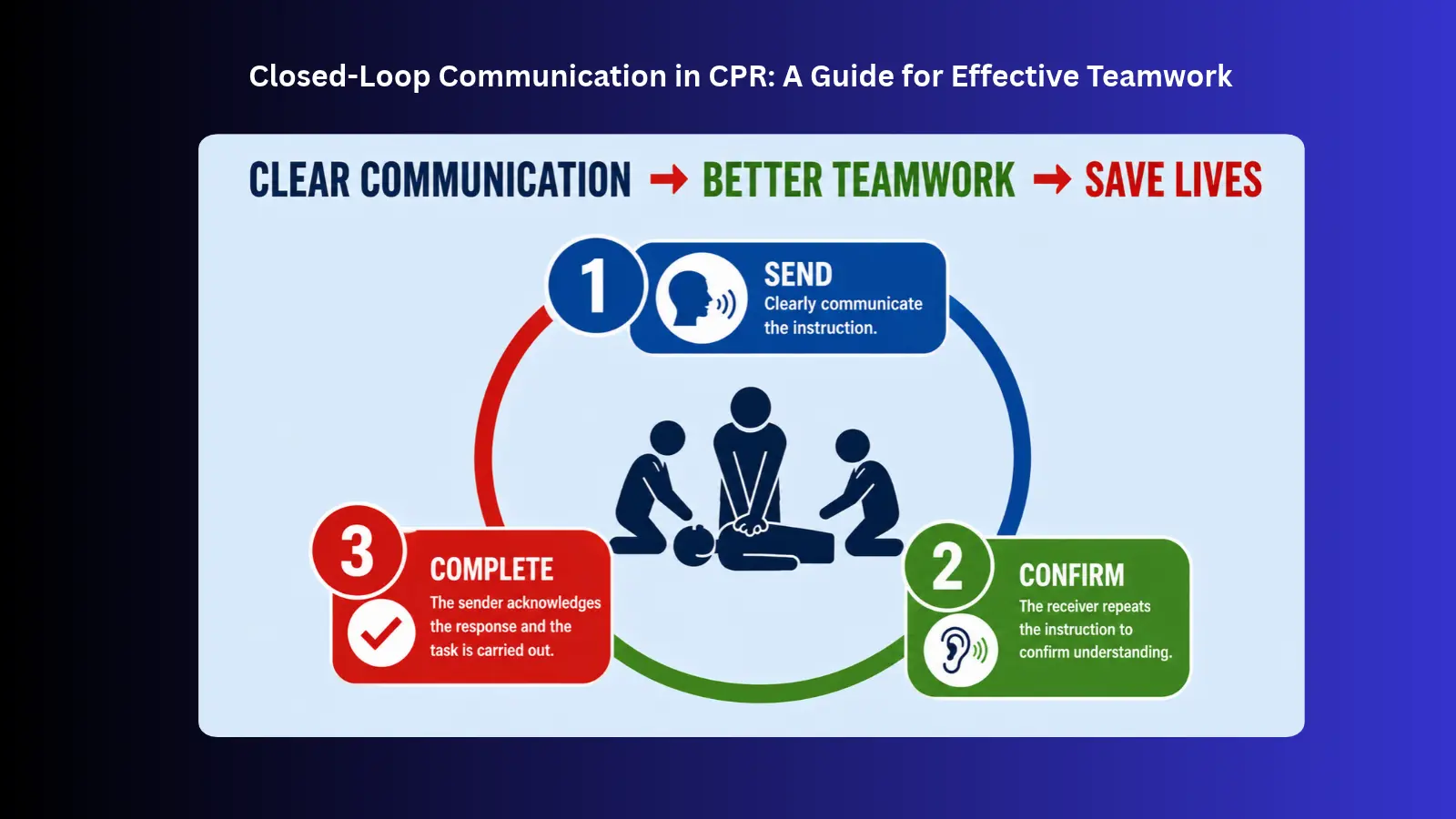
The process includes three basic steps that help team members stay clear about their responsibilities. These steps create a clear exchange between the person giving the instruction and the team member carrying it out.
Step 1: Give a Clear Instruction (Sender)
The team leader gives a clear and specific instruction to a designated team member, explaining exactly what action they need to take. Addressing the person by name or role helps avoid confusion about who is responsible for the task. For example, the team leader may say, “Sarah, give 1 mg of epinephrine.” This makes the assignment clear and allows Sarah to focus on the task she has been given.
Step 2: Repeat the Instruction (Receiver)
The team member who receives the instruction repeats the task aloud to confirm that they understood what the team leader asked them to do. This response allows the team leader to identify and correct any misunderstanding before the team member carries out the task. For example, Sarah may respond, “I’m giving 1 mg of epinephrine.” The team leader now knows that Sarah received and understood the instruction.
Step 3: Acknowledge the Response (Sender)
The team leader acknowledges the team member’s response and confirms that the instruction was understood correctly. This tells the team member that they can proceed with the assigned task and completes the communication exchange. For example, the team leader may say, “Correct, give it now.” This final confirmation helps keep the team aware of what has been assigned and what action is taking place.
Why Is the Check-Back Method Important in CPR?
Closed-loop communication helps CPR teams coordinate critical tasks by making sure instructions are clearly assigned, understood, and confirmed. During resuscitation, multiple team members may need to perform different tasks simultaneously. Without clear instructions, a task may be missed, delayed, or performed by more than one person.
Key benefits include:
- Prevents misunderstandings: Repeating an instruction allows the team leader to confirm that the team member understood the task correctly.
- Clarifies responsibilities: Assigning an instruction to a specific team member makes it clear who is responsible for completing the task.
- Reduces missed or duplicated tasks: Confirming assignments helps the team know which tasks have been completed and which still need to be performed.
- Supports timely interventions: Clear instructions help team members coordinate tasks such as chest compressions, defibrillation, medication administration, and airway management effectively.
- Strengthens team coordination: Consistent confirmation helps the team leader maintain awareness of ongoing actions and keeps team members informed about their roles during resuscitation.
Closed-Loop Communication in BLS, ACLS, and PALS
Read-back and confirmation communication help teams verify instructions during resuscitation. The specific tasks may vary depending on the patient’s age, condition, and level of care. The table below highlights how this communication approach is used in BLS, ACLS, and PALS.
| Course | How Reciprocal Communication is Used | Example |
| BLS | Team members use closed-loop communication to assign and confirm basic resuscitation tasks, including chest compressions, ventilation, AED operation, and switching compressors. | Leader: “Alex, start chest compressions.” Alex: “I’m starting chest compressions.” Leader: “Correct.” |
| ACLS | Team members use check-back communication to coordinate advanced resuscitation interventions, including rhythm assessment, defibrillation, medication administration, vascular access, and airway management. | Leader: “Maria, give 1 mg of epinephrine.” Maria: “I’m giving 1 mg of epinephrine.” Leader: “Correct, give it now.” |
| PALS | Team members use read-back communication to coordinate pediatric resuscitation tasks, including assessment, CPR, ventilation, medication administration, and rhythm management. | Leader: “David, prepare the medication using the child’s weight.” David: “I’m preparing the medication based on the child’s weight.” Leader: “Correct.” |
Common Communication Challenges During CPR
During CPR, effective communication helps the resuscitation team maintain a shared understanding of the patient’s condition and the overall response. Recognizing common communication challenges can help team members communicate more effectively and support coordinated patient care
Unclear Task Assignments
Instructions that do not identify who should perform a task can leave team members unsure about their responsibilities. A direct instruction should identify the appropriate person and clearly state the action required.
No Confirmation of Instructions
A team leader may give an instruction without knowing whether the assigned person heard or understood it correctly. Without confirmation, a medication, defibrillation preparation, airway intervention, or other task may be delayed or overlooked.
Multiple People Speaking at Once
When several team members speak at the same time, important instructions may be missed. Hearing different instructions at once can make it difficult to identify the correct task to perform.
Noise and Distractions
Alarms, equipment, movement around the patient, and other activities can interfere with verbal instructions. Team members may need to speak clearly and keep important updates focused on the patient’s care.
Failure to Report Task Completion
A team leader needs to know when an assigned action has been completed or when a problem prevents it from being carried out. Reporting the result allows the team to adjust its next actions and avoid assuming that an unfinished task has already been completed.
Effective Check-Back Communication Techniques During CPR
Clear communication helps CPR teams maintain awareness of assigned responsibilities and changes in the patient’s condition. Check-back communication helps team members confirm instructions, complete assigned tasks, and report their actions without disrupting ongoing resuscitation.
- Address the Appropriate Team Member: Direct each instruction to the specific person responsible for completing the task. Naming the individual or role helps prevent confusion about who should act.
- Give Clear, Specific Instructions: State the action precisely and include important details such as the intervention, medication, dose, or timing when relevant.
- Confirm and Verify the Instruction: The receiving team member should repeat the instruction or provide a clear confirmation. If the response is incorrect or incomplete, the sender should clarify the instruction before the task is performed.
- Report Task Completion: After completing an assigned intervention, the team member should inform the team leader of the action taken and any relevant results. This confirms completion and helps the team determine the next appropriate step.
- Communicate Important Changes: Share relevant changes in the patient’s condition, unexpected findings, or treatment response with the team leader. This keeps the team informed as the resuscitation progresses.
- Prioritize Critical Information: Communicate information that directly affects patient care first. Unnecessary discussion can distract team members from active resuscitation responsibilities.
- Clarify Responsibility During Team Changes: When a team member takes over a task, clearly communicate the change and provide any necessary information about the current status of that responsibility.
- Practice Communication During Simulation: CPR practice sessions can reveal unclear instructions, missed confirmations, or problems with task handoffs. Reviewing these issues helps teams improve communication during future resuscitation events.
Best Ways to Learn Repeat-Back Communication
Learning reciprocal communication involves understanding how team members exchange information during resuscitation and applying that process during practice. CPR trainees and healthcare professionals can strengthen this skill through structured practice and feedback that helps improve communication with other team members.
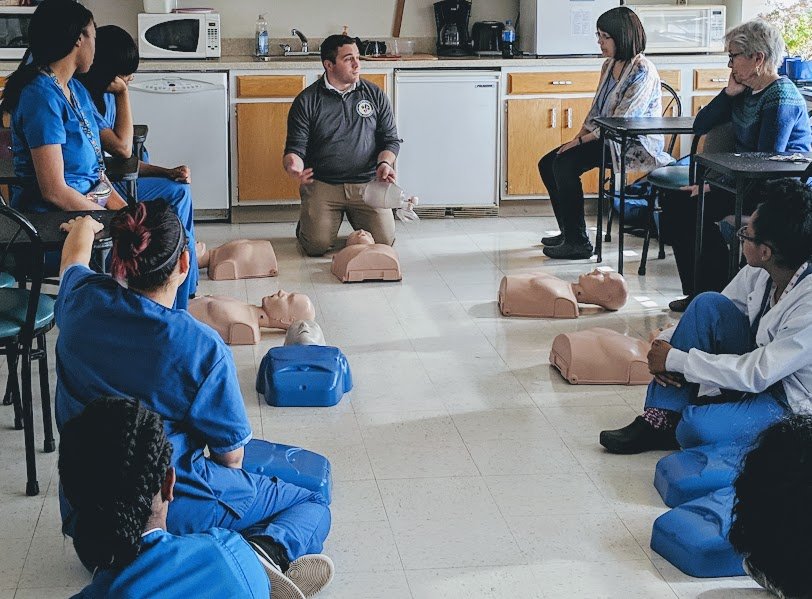
- Learn the Communication Process in CPR Training: Participate in an accredited BLS or ACLS course to learn how repeat-back communication supports effective team coordination during resuscitation. Training allows participants to apply these communication principles while practicing CPR team responsibilities.
- Practice Giving and Receiving Instructions: Work with other trainees to practice giving specific instructions and responding with clear confirmations. Repeated practice can make these responses more natural during an emergency.
- Apply Communication to CPR Tasks: Practice call-back communication while assigning and completing common CPR responsibilities, such as starting compressions, using an AED, checking a pulse, or preparing an intervention.
- Practice in Different Team Roles: Rotate between team leader and team member responsibilities during training activities. This helps trainees understand how information should be communicated from both sides of an instruction.
- Review Communication After Practice: Discuss missed confirmations, unclear instructions, or incomplete task reports after each practice session. Reviewing these issues can help identify specific areas for improvement.
- Use Feedback to Improve: Ask instructors or other team members to evaluate the clarity of instructions, accuracy of responses, and reporting of completed tasks. Specific feedback can help strengthen communication skills over time.
Improve CPR Team Performance Through Closed-Loop Communication
Closed-loop communication can improve CPR team performance by helping team members understand their responsibilities, confirm instructions, and clearly report completed tasks. This approach supports better coordination during resuscitation and helps the team maintain awareness as patient care progresses.
Bayside CPR offers AHA ACLS, BLS, PALS, and Heartsaver courses to help participants develop essential CPR and resuscitation skills. Our multiple verification stations provide convenient options for completing the required hands-on practice. This flexibility can help streamline the certification process, allowing you to receive your AHA digital eCard on the same day.