
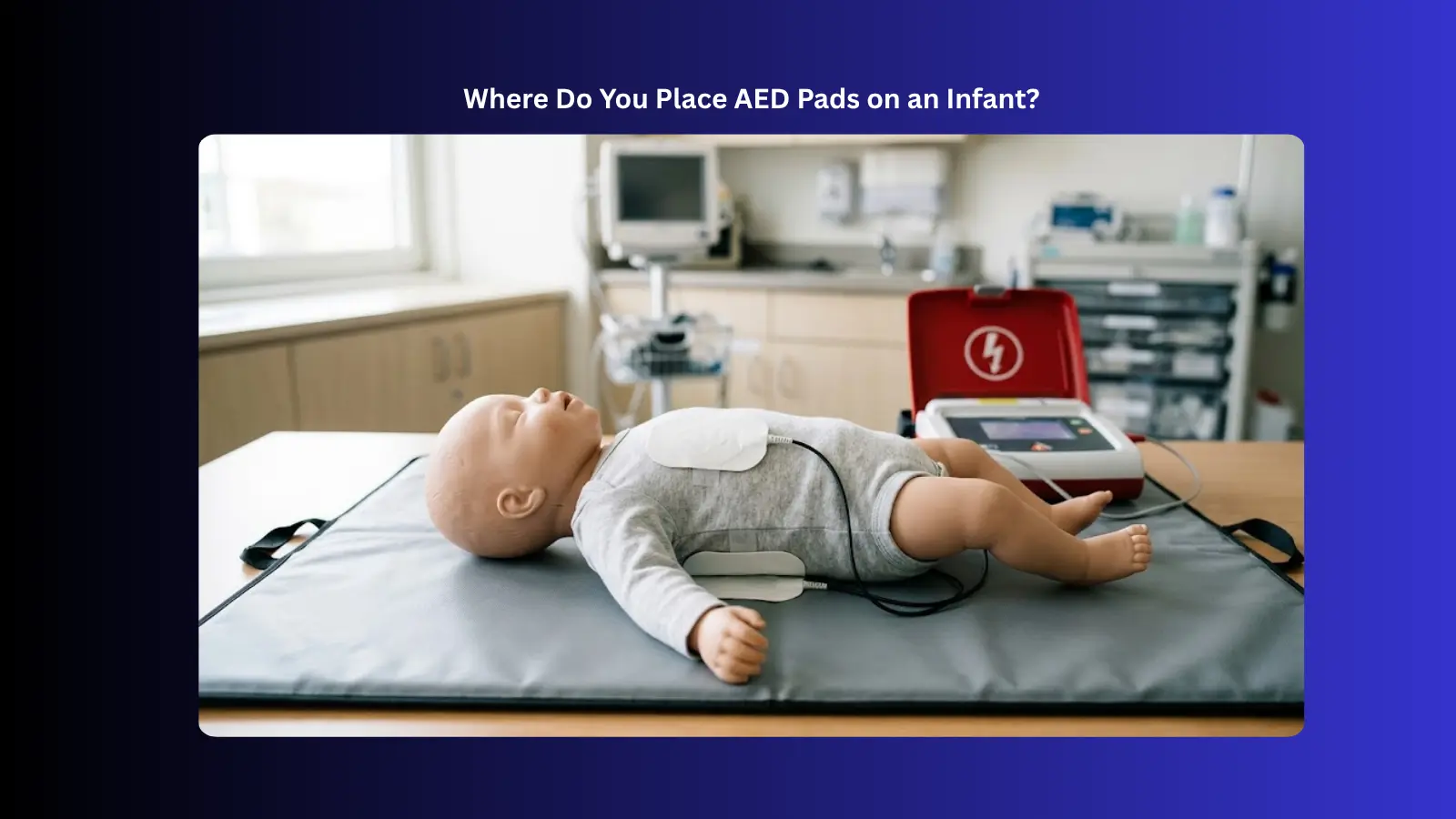
For an infant in cardiac arrest, AED pads can be placed in an anteroposterior position, with one pad on the chest and the other on the back. Anterolateral placement may also be reasonable when the pads can remain properly separated. Use pediatric pads and a pediatric attenuator when available.
Using an AED on an infant can raise questions about the equipment, pad size, and proper placement. The available space on an infant’s chest makes careful positioning important, particularly when using larger pads. This article covers pediatric and adult AED equipment, correct pad placement, common placement problems, and what to do when pediatric equipment is not available.
When Is an AED Needed for an Infant?
An AED may be needed when an infant is unresponsive, not breathing normally, and has no pulse. Abnormal gasping can also occur during cardiac arrest. These signs indicate a life-threatening emergency that requires immediate CPR, activation of the emergency response system, and use of an AED as soon as it is available.
If another person is present, ask them to retrieve an AED while you begin CPR. The device can assess the infant’s heart rhythm and deliver a shock when needed.
How Should You Position AED Pads on an Infant?
Anteroposterior placement can be useful for a small infant when positioning the pads on the front and back allows adequate separation. Place one self-adhering pad on the center of the bare chest and the other on the center of the back. Make sure the pads do not touch or overlap.
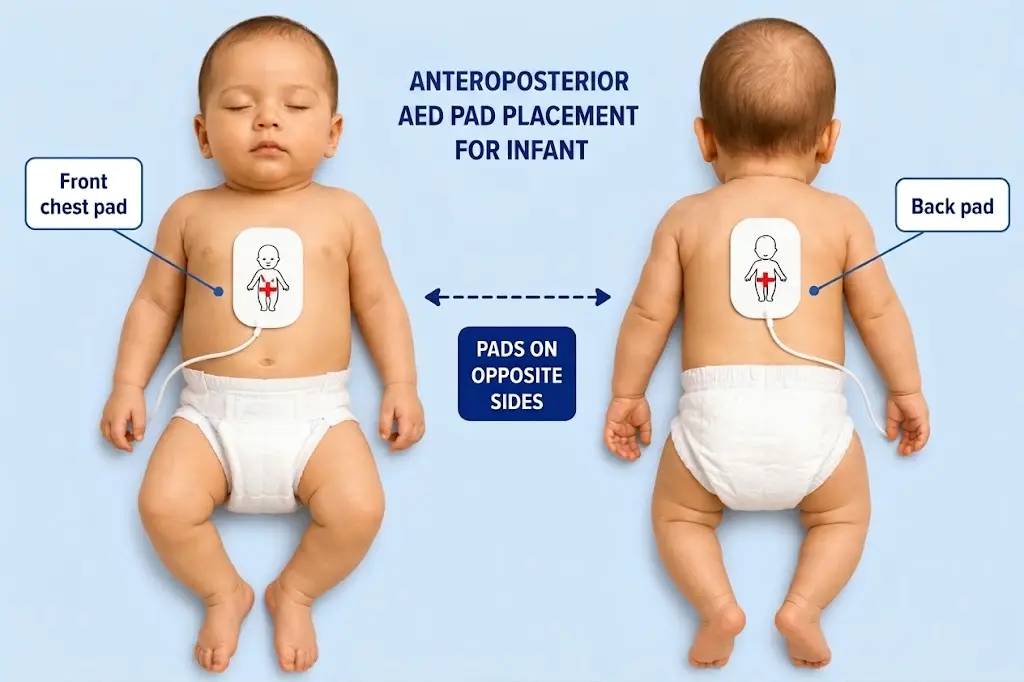
Anterolateral placement may also be reasonable when the infant’s size allows the pads to remain properly separated. With this arrangement, place one pad on the right side of the chest and the other on the left side of the chest. Avoid placing a pad over breast tissue or the abdomen.
Pad size and the infant’s chest area should guide pad placement. The key requirement is to maintain adequate separation between the pads so they do not touch or overlap.
Pediatric AED Pads vs. Adult Pads
Pediatric and adult AED pads differ based on the patient’s age and size. The table below compares their intended use, energy delivery, pad size, placement, and options when pediatric equipment is unavailable.
| Feature | Pediatric AED Pads | Adult AED Pads |
| Intended use | Infants and children when pediatric pads or a pediatric attenuator are available | Adults and older children; may also be used for infants and children when pediatric equipment is unavailable |
| Energy delivery | Used with a pediatric attenuator to reduce the energy delivered to the infant or child | Delivers the AED’s standard energy output without pediatric attenuation |
| Pad size | Use the largest pads that fit while maintaining adequate separation | Use pads that fit the patient’s chest while maintaining adequate separation |
| Placement | Anteroposterior or anterolateral placement may be reasonable | Usually anterolateral placement for adults |
| If pediatric pads are unavailable | Not applicable | May be used for an infant or child when a pediatric attenuator is unavailable; make sure the pads do not touch |
If adult pads are the only option, do not delay defibrillation while looking for pediatric equipment. Follow the AED manufacturer’s instructions when using the available pads.
What If Pediatric AED Pads Are Not Available?
Do not delay defibrillation while looking for pediatric pads. If an AED with a pediatric attenuator is unavailable, the 2025 AHA guidelines state that an AED without this feature may be considered for an infant or child.
When adult pads are the only option, place them so they do not touch or overlap. On a small chest, an anteroposterior arrangement may provide the separation needed to keep the pads apart. The AHA lay rescuer algorithm also instructs rescuers using adult pads to ensure the pads do not touch each other.
How Do You Use an AED During Infant CPR?
Using an AED on an infant follows a simple sequence. The device provides prompts throughout the process. Listen carefully to the AED and follow its instructions.
- Turn on the AED: Follow the device prompts as soon as it arrives.
- Expose the infant’s chest: Remove clothing from the area where the AED pads will be placed.
- Attach the appropriate pads: Use pediatric pads when available and position them so they remain properly separated.
- Allow the AED to analyze the rhythm: Stop touching the infant when the device tells you to stand clear.
- Deliver a shock if advised: Make sure nobody is touching the infant during shock delivery.
- Resume CPR immediately: Follow the AED prompts and continue CPR until the device tells you to pause again or medical professionals take over.
The AHA emphasizes minimizing interruptions during resuscitation. CPR and AED use work together to support effective resuscitation, with chest compressions resumed immediately after a shock.
Common AED Pad Placement Problems
A few practical problems can interfere with proper pad contact. Before attaching the pads, check the chest and make sure the placement area is suitable for the adhesive surface.
- Wet or damp skin: Dry the chest if moisture prevents the pads from adhering properly.
- Medication patches: Follow the AED manufacturer’s instructions if a medication patch is located where an AED pad needs to be placed. Do not place the pad directly over the patch.
- Pads touching: Reposition the pads if they touch or overlap. Adequate separation is important for effective current flow.
- Poor adhesion: Make sure clothing, moisture, or other material is not preventing the pad from making proper contact with bare skin.
- Long pauses in CPR: Avoid spending unnecessary time adjusting pad placement. Once the pads are positioned correctly, follow the AED prompts and return to CPR when instructed.
Using an AED With One Rescuer or Two Rescuers
When two rescuers are present, one person can perform CPR while the other retrieves, prepares, and operates the AED. This division of responsibilities can help reduce interruptions and allow the device to be used as soon as it becomes available.
When you are alone, the sequence depends on the situation. The 2025 pediatric BLS algorithm directs rescuers to activate the emergency response system, begin CPR when the infant is not breathing normally, and use the AED as soon as it becomes available. For a sudden witnessed collapse, retrieving the AED immediately is appropriate.
What About AED Use on a Newborn?
A newborn requires a different approach than an older infant. The 2025 AHA pediatric BLS guidelines specifically exclude newborn infants, who have separate considerations during the transition from birth to the neonatal period.
For a newborn who needs care around the time of birth, healthcare professionals should follow the American Heart Association neonatal resuscitation guidance and appropriate training. The circumstances surrounding the emergency determine which resuscitation approach applies, so pediatric BLS instructions should not be applied to a newborn without considering the appropriate neonatal protocol.
Strengthen Your Pediatric CPR Skills With Bayside CPR
Proper AED pad placement is only one part of responding to a cardiac emergency involving an infant or child. Pediatric CPR education helps you build practical skills in CPR, AED use, airway management, and other techniques needed during an emergency.
Bayside CPR offers American Heart Association courses, including BLS, ACLS, PALS, and Heartsaver CPR AED, to help healthcare professionals and other learners develop essential emergency response skills. Our courses prepare you for real-world emergencies and help you apply your skills when caring for infants and children. With convenient CPR Verification Stations throughout the United States, you can choose a location near you, complete your skills session, and receive your official AHA eCard upon successful completion.