
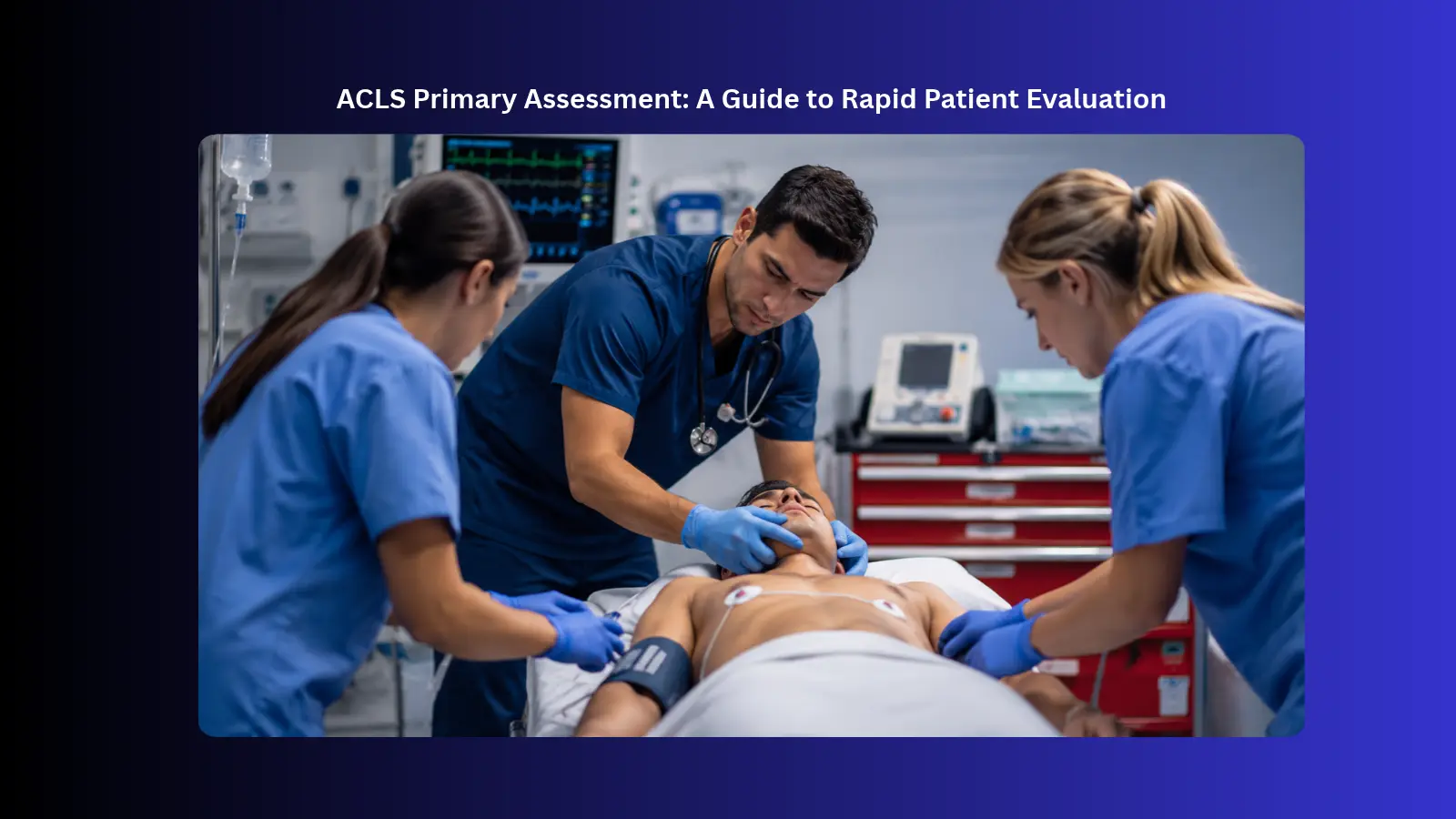
When a patient suddenly becomes critically ill, the first assessment needs to be focused, organized, and fast. The ACLS primary assessment helps healthcare professionals quickly identify life-threatening problems and decide which conditions require immediate treatment. Rather than trying to identify every possible problem at once, the assessment focuses on the conditions that can quickly cause deterioration.
Primary assessment is not simply a checklist of observations. Each part provides important information about the patient’s condition while helping the healthcare team recognize changes that require immediate action.
This guide explains the ACLS primary assessment, the ABCDE approach, key clinical priorities, common mistakes, and practical tips for rapid patient evaluation.
What Is the ACLS Primary Assessment?
The ACLS primary assessment is a rapid evaluation used to identify and manage immediate threats to a patient’s airway, breathing, circulation, and neurological status. The process is commonly organized around the ABCDE approach, allowing the healthcare team to address the most urgent problems before moving to less immediate concerns.
Healthcare professionals should reassess the patient after each intervention and monitor for changes in their condition. A patient who initially appears stable can deteriorate quickly, making ongoing evaluation an important part of emergency care.
Why Is Rapid Patient Evaluation Important in ACLS?
Rapid patient evaluation helps healthcare professionals identify life-threatening problems early and begin appropriate treatment promptly. A structured assessment provides a clear way to identify immediate concerns involving the airway, breathing, circulation, and neurological status.
Helps Identify Airway Problems
Airway obstruction can prevent adequate oxygen from reaching the lungs and may quickly lead to respiratory and cardiac complications. During the initial assessment, healthcare professionals look for signs such as abnormal airway sounds, difficulty speaking, or visible obstruction so appropriate airway support can be provided promptly.
Recognizes Breathing Problems
Assessing breathing helps determine whether the patient is moving air effectively. Healthcare professionals evaluate respiratory rate, chest movement, breathing effort, and oxygenation while looking for signs of respiratory distress or inadequate ventilation.
Detects Circulation Problems
Poor circulation can reduce blood flow to vital organs and may indicate shock or cardiovascular compromise. Checking the pulse, blood pressure, skin appearance, and other signs of perfusion helps the team recognize circulation problems and determine whether immediate intervention is needed.
Identifies Changes in Mental Status
A change in mental status can provide an important clue about the patient’s condition. Altered responsiveness may be associated with inadequate oxygenation, poor circulation, low blood glucose, stroke, or other serious problems, making neurological assessment an important part of the primary evaluation.
Supports Clear Team Communication
Rapid evaluation gives the healthcare team a consistent framework for sharing information during an emergency. When team members follow the same assessment sequence, findings can be reported clearly, and priorities can be established without unnecessary confusion.
Helps Prioritize Immediate Interventions
Primary assessment helps the team determine which problem requires attention first. Life-threatening findings are addressed immediately, while less urgent concerns can be evaluated after the patient’s immediate threats have been managed.
Encourages Continuous Reassessment
Patient evaluation does not stop after the first assessment. Reassessing the patient after an intervention helps determine whether the treatment is working and whether new problems have developed.
The ABCDE Approach in ACLS Primary Assessment
The ABCDE approach provides a systematic method for assessing a critically ill patient and identifying emergency conditions. Each step focuses on a specific area, helping healthcare professionals recognize urgent problems and address them in the appropriate order.
A: Airway
Determine whether the airway is open, clear, and protected. Check for blood, vomit, secretions, or foreign objects, and listen for abnormal sounds such as snoring, gurgling, or stridor.
Use the head-tilt chin-lift when cervical spine injury is not suspected, or the jaw thrust when it is suspected. Consider an oropharyngeal or nasopharyngeal airway when indicated, and use an advanced airway when appropriate, with placement confirmed using quantitative waveform capnography.
B: Breathing
Check respiratory rate, chest expansion, breath sounds, work of breathing, and oxygenation. Watch for signs of respiratory distress or inadequate ventilation.
Provide supplemental oxygen when indicated and use bag-valve-mask ventilation when breathing is inadequate. During cardiac arrest, provide oxygen with appropriate ventilation, and use end-tidal carbon dioxide monitoring when indicated to assess ventilation and monitor an advanced airway.
C: Circulation
Check the pulse, blood pressure, heart rhythm, and signs of adequate tissue perfusion. If no pulse is present, recognize cardiac arrest and begin high-quality CPR while applying a monitor or defibrillator.
Identify shockable rhythms, such as ventricular fibrillation and pulseless ventricular tachycardia, and nonshockable rhythms, such as asystole and pulseless electrical activity. Follow the adult cardiac arrest algorithm to guide rhythm-specific resuscitation. Establish IV or IO access when indicated and provide appropriate interventions, such as defibrillation or medications, based on the patient’s condition.
D: Disability
Perform a rapid neurological check by assessing the patient’s level of consciousness and noting any changes in mental status. AVPU provides a quick measure of responsiveness, while the Glasgow Coma Scale can be used when a more detailed neurological assessment is needed.
Check pupil size and reactivity when appropriate, and obtain a blood glucose measurement when altered mental status may be related to hypoglycemia or another metabolic problem. When stroke is suspected, follow the ACLS Suspected Stroke Algorithm for further assessment and management
E: Exposure
Expose the patient as needed to identify findings that may not be visible during the initial examination. Look for hidden bleeding, trauma, burns, rashes, swelling, medical alert information, or medication patches that may provide clues about the patient’s condition.
Examine the patient systematically while maintaining privacy and dignity. After the examination, cover the patient and use appropriate warming measures to help prevent hypothermia.
Primary Assessment vs. Secondary Assessment in ACLS
Primary and secondary assessments serve different purposes during an ACLS emergency. The primary assessment focuses on identifying problems that require immediate attention, while the secondary assessment gathers additional information to identify possible causes and guide further treatment.
| Assessment | Primary Assessment | Secondary Assessment |
| Main purpose | Identify urgent problems and determine which interventions are needed first. | Gather more detailed information to identify possible causes and guide ongoing care. |
| Timing | The initial evaluation occurs when the patient is first encountered, with immediate problems identified and managed as needed. | Follows the initial evaluation once immediate concerns have been addressed or managed. |
| Approach | Uses the ABCDE sequence to check airway, breathing, circulation, neurological status, and exposure. | Uses a more detailed history, focused examination, and additional diagnostic information. |
| Key information | Responsiveness, airway patency, breathing, pulse, circulation, mental status, and other urgent findings. | SAMPLE history, medical history, medications, allergies, symptoms, recent events, and other relevant clinical information. |
| Clinical actions | May include CPR, defibrillation, airway support, oxygen or ventilation, rhythm assessment, and other immediate interventions when indicated. | May include a focused physical examination, 12-lead ECG, laboratory testing, and assessment for reversible causes of cardiac arrest, including the Hs and Ts. |
| Priority | Rapid recognition and management of problems that require immediate treatment. | Detailed evaluation to understand the patient’s condition and determine appropriate ongoing management. |
Common Mistakes During the Primary Assessment
A structured approach can help reduce errors during a high-pressure emergency, but healthcare professionals should remain alert to common assessment problems. Completing an AHA ACLS course can help reinforce assessment skills and appropriate responses during resuscitation.
Common mistakes include:
- Ignoring scene safety: Failing to check for environmental hazards or use appropriate personal protective equipment before approaching the patient.
- Overlooking immediate problems: Focusing on less urgent findings before addressing urgent problems involving the airway, breathing, or circulation.
- Focusing too much on one finding: Becoming distracted by an obvious injury or symptom and missing other important clinical signs.
- Starting a detailed assessment too soon: Spending time on a complete history or examination before addressing urgent findings.
- Making assumptions too early: Attributing the patient’s condition to one suspected cause before completing the initial evaluation.
- Failing to reassess: Not checking the patient’s response after an intervention or overlooking changes in their condition.
- Poor team communication: Failing to share important findings, confirm completed tasks, or communicate changes in the patient’s condition can create confusion during resuscitation.
Practical Tips for ACLS Primary Assessment
A strong primary assessment requires more than moving through a fixed sequence. Healthcare professionals should stay focused on the patient’s changing condition, respond to important findings as they appear, and keep the resuscitation team informed throughout the process.
Keep the Team Informed
Share important findings and changes in the patient’s condition with the resuscitation team. Understanding Resuscitation Triangle Roles can help team members maintain clear responsibilities and coordinate their actions during an emergency.
Prioritize Urgent Findings
Give immediate attention to findings that can rapidly affect the patient’s condition. Do not allow less urgent concerns to distract from problems requiring prompt intervention.
Monitor the Patient’s Response
Pay attention to changes after an intervention rather than assuming the problem has been corrected. Repeat relevant checks and adjust care when the patient’s condition does not improve.
Record Important Findings
Document relevant findings, interventions, and the patient’s response during or after the emergency response. Accurate records help communicate what occurred and support continued patient care.
Use Clinical Information Together
Consider physical findings, vital signs, cardiac rhythm, oxygenation, and other available monitoring information together. Sharing and interpreting these findings collectively supports effective teamwork and helps guide appropriate patient care.
Get ACLS Certified With Bayside CPR
A strong understanding of the ACLS primary assessment helps healthcare professionals recognize urgent patient needs and prioritize appropriate interventions. Learning the ABCDE approach, recognizing important findings, and knowing when to reassess can support organized decision-making during cardiovascular emergencies.
At Bayside CPR, we offer AHA-accredited ACLS certification through a blended learning format. Complete the online portion from any device, then book your hands-on skills session at one of our verification stations. You can choose a nearby training station to complete your skills competency check, helping reduce travel time. Same-day certification is available, and our AHA ACLS certification is accepted across the United States.